The Best Chess Moves:
Principles, Tactics & Legendary Examples
From universal principles to the greatest moves ever played — a complete guide to understanding, recognising, and finding the best chess move in any position, with Stockfish verification at every step.
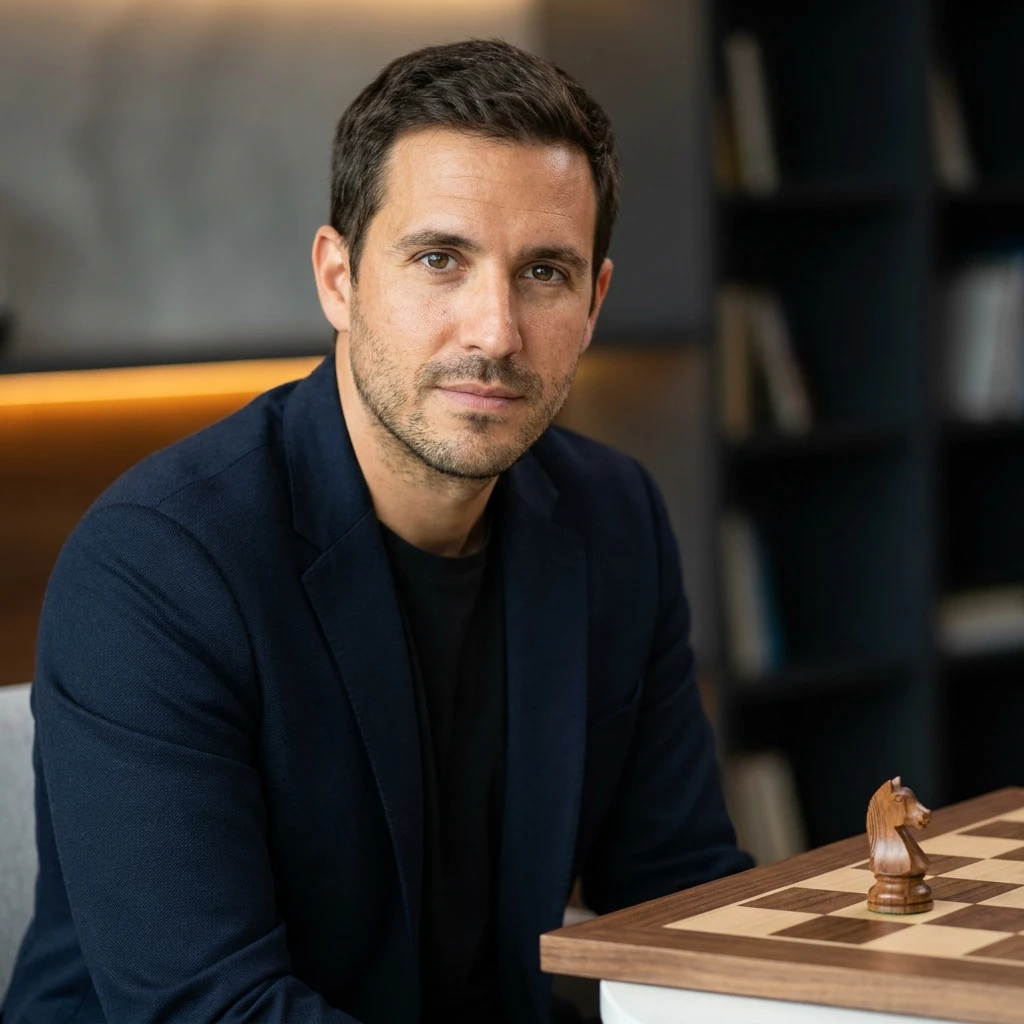 Alex Torres
The best chess move in any position is the one that satisfies all five core principles: control the center, develop pieces actively, ensure king safety, coordinate pieces harmoniously, and create or exploit weaknesses in the opponent’s position. In practice, the best move is verified by Stockfish — the world’s strongest chess engine — which evaluates millions of positions per second using an NNUE neural network to identify objectively optimal play.
- What Makes a Chess Move the “Best”?
- The 5 Universal Principles Behind Best Chess Moves
- Best Opening Moves and Win Rate Statistics
- Best Tactical Chess Moves — Patterns Every Player Must Know
- The Greatest Chess Moves of All Time
- How to Find the Best Chess Move in Any Position
- Best Chess Moves for Beginners
- Using Stockfish to Find Best Moves — Free with ChessAlgo
- Frequently Asked Questions
What Makes a Chess Move the “Best”?
There is no single “best chess move” in isolation. The quality of any chess move is entirely determined by the position it is played in. A move that wins brilliantly on move 25 of one game can be a catastrophic blunder in a position that differs by a single pawn. Every chess move must be evaluated in context.
The modern definition of the “best move” in any position comes from computer chess: it is the move that maximises the expected outcome, calculated to sufficient depth by a chess engine operating under optimal conditions. Stockfish — currently the world’s strongest chess engine with an estimated ELO rating of over 3,500 — evaluates positions using a combination of alpha-beta search and NNUE (Efficiently Updatable Neural Network) evaluation, calculating hundreds of millions of positions per second to identify objectively best play.
But engine perfection is not the whole story. For human players, the “best” move is better defined as the move that best satisfies the positional and tactical requirements of the position, within the calculation capacity of the player. A move that is technically second-best according to Stockfish but is clearly strategically correct and within your calculation ability is more “best” for your practical game than an engine suggestion you do not understand.
Any candidate for the best move in a position should satisfy: (1) Tactical soundness — the move does not hang material or allow a decisive combination. (2) Strategic improvement — the move improves your position, restricts your opponent, or advances your plan. (3) Engine verification — at depth 20+, Stockfish confirms the evaluation is consistent with your assessment. All three criteria together define the best move.
Understanding what makes moves great — and what makes them terrible — is the most transferable knowledge in chess. Memorising specific lines helps in specific positions. Understanding why certain moves are best helps in every position you will ever face.
The 5 Universal Principles Behind Best Chess Moves
Grandmasters do not calculate every possible move when deciding what to play. They filter candidate moves through a set of deeply internalised principles that immediately eliminate bad moves and highlight strong ones. These five principles are the foundation behind virtually every strong chess move at every level of play.
Control the Center
The four central squares — d4, d5, e4, e5 — are the most strategically important on the board. Pieces placed near the center control more squares than pieces placed near the edges. The best opening moves almost invariably support central control, whether by occupying central squares directly (1.e4, 1.d4) or by preparing to challenge the center indirectly (1.Nf3, 1.c4).
Chess engines consistently confirm this principle: the top-ranked first moves according to Stockfish are all central or central-supporting moves. Flank openings can be excellent, but they work by controlling the center from a distance — the principle holds regardless of style.
Develop Pieces Efficiently
A piece on its starting square controls almost nothing. Development — moving pieces to active squares where they influence the game — is the most important early task in any chess game. The best moves in the opening develop a new piece or support the development of another. Moving the same piece twice before all other pieces are developed is almost always suboptimal unless there is a tactical reason.
Efficient development means: knights before bishops (knights have only one optimal square each in most openings; bishops can wait), castling before launching an attack, and connecting rooks before committing to any plan.
Ensure King Safety
An unsafe king is a vulnerability that overrides all other strategic considerations. No plan — no matter how strategically sound — survives a direct attack on an exposed king. The best moves in the middlegame always account for king safety first, whether through timely castling, creating pawn shelter, keeping defensive pieces nearby, or avoiding unnecessary weaknesses around the king.
The most common pattern in games where strong players are upset by weaker opposition is not tactical blindness — it is delayed castling. Players who push pawns aggressively in the opening without castling will frequently find their king exposed to a rapid mating attack.
Coordinate Pieces Harmoniously
Individual pieces are less powerful than coordinated piece systems. Two rooks on an open file are dramatically stronger than two rooks on separate closed files. A bishop and knight attacking the same weakness are far more dangerous than the same pieces operating on opposite sides of the board. The best moves do not just improve one piece — they improve a piece in ways that increase the effectiveness of other pieces simultaneously.
This principle explains why grandmasters spend time on what appear to be “nothing moves” — rook lifts, king marches in the endgame, preparatory pawn moves. Each of these improves coordination across the entire piece array.
Create and Exploit Weaknesses
Chess is a game of accumulated advantages. The best moves either create a weakness in the opponent’s position — a weak pawn, an open file, a bad bishop, a vulnerable king — or exploit an already-existing weakness. Weaknesses that cannot be adequately defended are the foundation of all strategic victories.
The key insight here is that weaknesses must be permanent or semi-permanent to matter. A temporarily exposed piece that can be repositioned is not a real weakness. A permanently backward pawn on an open file, a bishop permanently blocked by its own pawns, or a king permanently stuck in the center — these are the targets that convert strategic advantages into wins.
Best Opening Moves in Chess — Win Rate Statistics
The best first move in chess has been debated for centuries. Modern engine analysis and database statistics across millions of grandmaster games have settled the question with far more precision than was historically possible. Here is what the data and Stockfish agree on.
The statistics confirm something important: the best first move is the one you understand most deeply. The difference in win rates between 1.e4 and 1.d4 at the amateur level is negligible — far smaller than the impact of understanding the resulting positions. Bobby Fischer famously called 1.e4 “best by test,” and most engine evaluations agree it provides the most direct path to an objective advantage. However, players who understand the Queen’s Gambit deeply will outperform players who play 1.e4 into unfamiliar territory every time.
Best Tactical Chess Moves — Patterns Every Player Must Know
Tactical chess moves are the most visually dramatic category of best moves — combinations that win material, force checkmate, or fundamentally change the character of a position through forcing sequences. These are the moves that end games, generate brilliancy prizes, and define chess careers. Every strong player has these patterns so deeply internalised that they recognise them instantly.
The Greatest Chess Moves of All Time
Throughout chess history, certain moves have stood out not just as the best option in the position, but as genuinely astonishing departures from what seemed possible — moves that redefined what chess could look like and demonstrated a level of calculation or intuition that stunned everyone who witnessed them. These are the moves that make chess endlessly compelling.
Bobby Fischer — Bxh2+ vs Pal Benko, 1963
Fischer’s chess career was defined by moves that looked absurd until you saw what followed. His bishop sacrifice against Benko — played in a US Championship game — was a calculated demolition that demonstrated his ability to see five and six moves deeper than anyone else in the room. Fischer finished his 1963–64 US Championship campaign with a perfect score of 11/11, still the only perfect score in the history of the event.
Donald Byrne vs Bobby Fischer — …Bxb4!! 1956
Known simply as “The Game of the Century,” Fischer was 13 years old when he played this game. The move …Be6!! on move 17 — a deliberate queen sacrifice against a much older and stronger player — was not just a brilliant tactical sequence. It was the moment the chess world realised a different kind of player had arrived. Stockfish, at maximum depth, agrees: the queen sacrifice was objectively the best move in that position, but virtually no human player would have found it.
Garry Kasparov — Rxb2!! vs Anand, Riga, 1995
Kasparov’s rook sacrifice in Riga 1995 was described by commentators as incomprehensible in real time. The rook sacrifice worked not through a single clean forced line, but through a series of complications that Kasparov had calculated further than any human had a right to. It is the defining example of “monster” moves — moves so deeply calculated that even strong grandmasters cannot verify them at the board.
Veselin Topalov — Rxd4!! vs Kasparov, Linares 1999
Kasparov called the game in which this rook sacrifice appeared the best chess game ever played — and Kasparov was playing White and lost. Topalov’s rook sacrifice, followed by a series of brilliant pawn advances and piece activity, created a position that was simultaneously won for Topalov and visually incomprehensible to most observers. The game demonstrated that sacrifices do not always need an immediate forcing line — sometimes the compensation is purely positional and dynamic.
Magnus Carlsen — h4!! vs Simen Agdestein, 2022
Not every great chess move looks spectacular. One of Magnus Carlsen’s most celebrated recent moves was a quiet pawn advance — h4!! — that demonstrated the kind of prophylactic thinking that separates world-class chess from merely excellent chess. The pawn move restricted Agdestein’s entire kingside counterplay while maintaining Carlsen’s positional dominance. Simple in appearance, utterly decisive in effect. Stockfish confirmed the move as objectively best only at depth 28.
How to Find the Best Chess Move in Any Position
Finding the best chess move in practice requires a systematic thought process. Professional players use variations of the same methodology, developed and refined over decades of competitive play. The following thinking procedure can be applied to any position at any stage of the game.
“In my coaching, I tell every student the same thing: the best chess move is not the one Stockfish gives you — it is the strongest move you can find and fully understand at the board. Understanding always beats memorisation.”
Alex Torres — Chess Analyst & Founder, ChessAlgo.comBest Chess Moves for Beginners
For players under 1,200 ELO, the concept of the “best chess move” is best understood through a small set of guiding principles rather than specific move-by-move theory. The following are the most impactful improvements beginner players can make to their move selection immediately.
| Principle | What It Means | Common Mistake It Fixes |
|---|---|---|
| Control e4/d4/e5/d5 | Place pawns and pieces so they influence the four central squares | Playing flank pawns (a3, h3) that do nothing in the opening |
| Develop all pieces first | Move every knight and bishop to active squares before pushing pawns | Moving one piece three times while others sit on starting squares |
| Castle by move 10 | King safety before any attack — always | Delaying castling while launching a premature attack |
| Connect your rooks | After castling, clear pieces between rooks so they protect each other | Rooks on a1 and h1 with pieces blocking them, unable to support each other |
| Check for captures before every move | Scan the board — can your opponent capture anything of yours for free? | Leaving pieces en prise (unprotected) |
| Trade equal pieces actively | A minor piece swap is fine if it opens lines for your remaining pieces | Keeping inactive pieces instead of trading them for activity |
Before every move, ask a single question: “Does my opponent have an immediate response that wins material or delivers checkmate?” If yes, you cannot play that move regardless of how good it looks in other ways. This single habit, applied consistently, eliminates the majority of blunders that keep beginner players stuck below 1,000 ELO.
Using Stockfish to Find Best Moves — Free with ChessAlgo
Stockfish is the gold standard for determining objectively best chess moves. Developed as an open-source engine since 2008, it has dominated computer chess for over a decade. The current version combines the classical alpha-beta search algorithm with an NNUE (Efficiently Updatable Neural Network) evaluation function — a neural network trained on hundreds of millions of positions from high-quality human and computer games.
The result is an engine that evaluates positions with a degree of accuracy previously impossible: detecting tactical threats at depth 25 that no human player could calculate, identifying structural weaknesses that would only become decisive thirty moves later, and providing precise centipawn evaluations that quantify advantages that humans can only describe qualitatively.
ChessAlgo provides unlimited access to Stockfish analysis for free. No daily limits. No account. No hidden features behind a paywall. The engine runs directly in your browser using WebAssembly technology — meaning your positions never leave your device and there is no server to slow down the analysis.
To find the best move in any position using ChessAlgo:
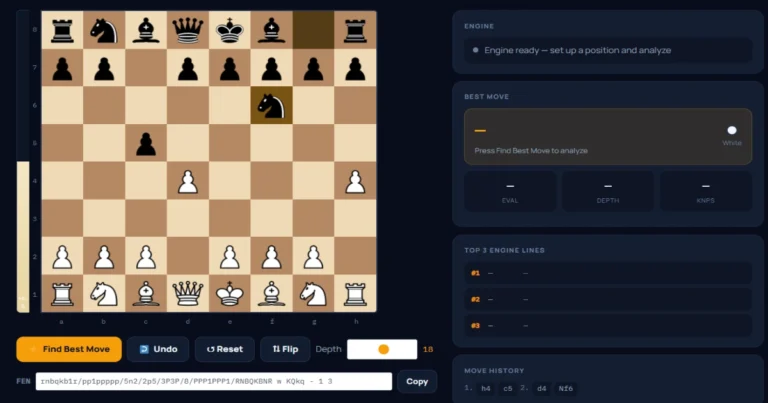
- →Set up the position on the interactive board, or paste a FEN string from Chess.com, Lichess, or any analysis tool
- →Set depth to 20 for normal positions, 22–25 for tactical or critical endgame positions
- →Press Find Best Move and read all three engine lines — the evaluation difference between lines tells you how forced the position is
- →Write down the strategic reason behind the best move — understanding the why creates the pattern recognition that transfers to your real games
Find the Best Move in Any Position
Free Stockfish analysis at depth 25. Three engine lines. Evaluation bar. No signup required. No limits. Paste any FEN and get results in seconds.
⚡ Open Free Calculator →- The “best chess move” is always position-dependent. There is no universally best move — only the move that best satisfies the five principles: central control, efficient development, king safety, piece coordination, and creating or exploiting weaknesses.
- Opening statistics show 1.e4 and 1.d4 are statistically near-equal first moves. The better choice is whichever you understand more deeply — understanding beats theory every time.
- The six most powerful tactical patterns are: fork, pin, skewer, discovered attack, back rank mate, and zwischenzug. Recognising these patterns instantly is the foundation of tactical strength at every level.
- The greatest chess moves in history — Fischer’s queen sacrifice, Kasparov’s rook sacrifice, Topalov’s Rxd4!! — were not always the most forcing. Many were the most deeply calculated or the most strategically profound.
- The six-step thought process: check forcing moves → identify opponent’s threats → improve worst piece → look for outpost squares → evaluate pawn breaks → verify with Stockfish.
- For beginners, the single most impactful habit is asking “can my opponent win material or deliver checkmate in response?” before every move. This eliminates the majority of sub-1000 blunders.
Frequently Asked Questions
Conclusion
The best chess moves are not mysteries reserved for grandmasters. They follow identifiable principles — central control, efficient development, king safety, piece coordination, and weakness creation. They exploit recognisable tactical patterns — forks, pins, skewers, discovered attacks. They are verified by tools that are now freely available to every player on the planet.
What separates strong players from average ones is not access to the knowledge of what best chess moves look like. It is the depth to which that knowledge has been internalised through study, analysis, and pattern recognition. Every game you analyze carefully, every tactical pattern you drill, and every engine suggestion you take the time to understand rather than merely note, adds to a compounding advantage over players who simply play game after game without reflection.
Use ChessAlgo’s free Stockfish calculator to verify every critical position in your games. Study the engine lines. Understand the principles behind the best moves. The gap between your current play and your potential is exactly the size of the pattern recognition you have not yet built — and game analysis is the most efficient way to build it.