How to Analyze Chess Games:
The Complete 7-Step Method
A proven methodology from 15 years of competitive play and 8 years of coaching — covering blind review, Stockfish analysis, and building a pattern log that actually improves your rating.
 Alex Torres
To analyze a chess game effectively: first replay it without an engine and identify critical moments, then write down your own assessment, and only then run Stockfish analysis at depth 20+. Compare your thinking against the engine. The goal is not to memorize engine moves — it is to understand why a move is better and build the pattern recognition that wins future games.
- Why Analyzing Your Games Is the Fastest Path to Improvement
- Step Zero: The Blind Review (Before You Touch the Engine)
- The 7-Step Game Analysis Method
- How to Read Stockfish Output Without Getting Lost
- What to Focus On at Your Rating Level
- 5 Analysis Mistakes That Kill Improvement
- Using ChessAlgo to Analyze Any Position
- Frequently Asked Questions
Why Analyzing Your Games Is the Fastest Path to Improvement
I have coached chess players at every level — from complete beginners struggling to see one move ahead, to 1700-rated club players stuck for two years at the same rating. The single clearest predictor of whether someone improves is not how many games they play. It is whether they analyze the games they play.
Most casual players follow the same loop: play a game, lose, feel frustrated, immediately start the next game. Then wonder why they are still making the same mistakes six months later. The games are the raw data. Analysis is the extraction of meaning from that data. Without it, you are practising the same errors at increasing speed.
Magnus Carlsen, the five-time World Chess Champion, has spoken extensively about his analytical process. During his formative years, he would spend hours reviewing every game — not just losses, but wins — looking for improvements and alternatives. The discipline of deep game analysis is not unique to Carlsen; it is a defining characteristic of every player who improves beyond the plateau that stops most club players.
Research from chess improvement communities consistently shows that players who analyze their games for 30 minutes after each session improve 2–4 times faster than those who simply play more games. Playing without analysis is the chess equivalent of going to the gym and doing the same exercise with bad form forever — you will get sore, but you will not get stronger.
Here is the uncomfortable truth I tell every student: the game you just played is the most valuable study material you have. It reflects your exact current weaknesses, your specific opening choices, and the precise types of positions you find yourself in. No textbook, no puzzle set, and no online course is as targeted as your own games. But only if you analyze them properly.
Step Zero: The Blind Review (Before You Touch the Engine)
Every serious chess analyst — whether a club player or a grandmaster — follows the same foundational rule: never open an engine before completing your blind review. This is the step most online guides skip. It is also the step that separates players who actually improve from those who simply watch impressive Stockfish moves without understanding them.
A blind review is exactly what it sounds like: you replay your entire game, move by move, without the engine running, and you stop at every point where you remember thinking, hesitating, or feeling uncertain. At each of those moments, you write down — even just in the game chat or a notebook — your answer to three questions:
- 01What did I think my opponent was threatening? Identifying threats is the most underdeveloped skill at the club level. Most blunders are not miscalculations — they are failures to ask “what is my opponent trying to do?”
- 02Why did I play the move I played? Articulating your reasoning out loud (or on paper) forces you to distinguish between moves you genuinely understood and moves you made instinctively or by habit.
- 03What alternatives did I consider? Listing the moves you rejected — and why — reveals your calculation process and often shows you exactly where it breaks down.
“The engine will always show you the best move. The blind review shows you your thinking process. If you skip it, you will never understand the gap between the two — and that gap is where improvement lives.”
Alex Torres, Chess Analyst & Founder of ChessAlgo.comIn my experience coaching players from 800 to 1700, the blind review alone — even without any engine at all — produces noticeable improvement within a few weeks. The act of forced self-examination disrupts the automatic playing mode that keeps most players stagnant. When you have to justify every move in writing, you very quickly discover which moves you cannot justify at all.
The 7-Step Game Analysis Method
After years of refining this process — first for my own games, then adapting it for the students I coached — I arrived at a seven-step methodology that consistently produces measurable improvement. Each step builds on the previous one. Skipping steps, especially the early ones, dramatically reduces the analytical value of everything that follows.
Get Your PGN and Set Up the Position
Export your game as a PGN (Portable Game Notation) file from Chess.com, Lichess, or wherever you played. Every major chess platform makes this a one-click process. If you played an over-the-board game, reconstruct it from your scoresheet or memory. You need the full move record before you can analyze anything.
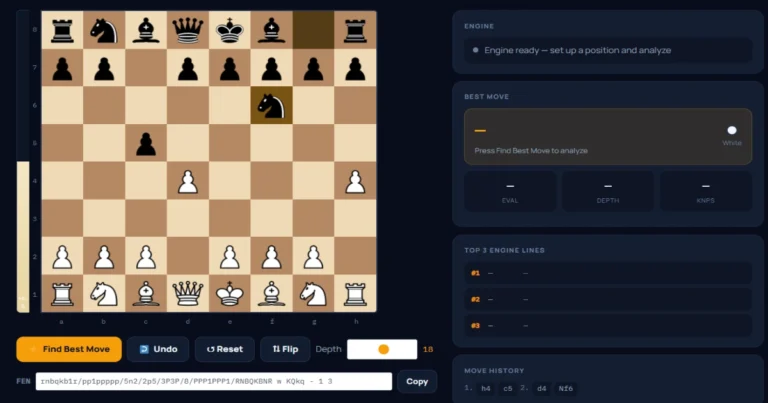
Load the PGN into your analysis tool. In ChessAlgo, you can paste the FEN of any specific position into the calculator’s FEN bar to jump straight to the moment you want to examine. This is useful when you already know which position troubled you and want to focus your engine time there.
First Pass — Replay Without the Engine
Play through every move of the game at a relaxed pace. Do not run any analysis. Just watch the game play out from start to finish, as if watching someone else’s game. This gives you the narrative overview — where was the game comfortable, where did it become tense, when did control shift from one player to the other?
During this first pass, mark any move that made you react — moves that surprised you, moves you were relieved your opponent missed, moments when you felt the game slip away, or moments when you sensed an opportunity you did not take. These marks become your analytical priorities in step three.
Identify and Annotate Critical Moments
Go back through the marked positions from step two and categorize them. A critical moment is any move where the evaluation could have shifted significantly — an opportunity missed, a mistake made, a defensive resource overlooked, or a transition point from one phase to another.
For each critical moment, write down in plain language what you think happened. Do not worry about chess notation or engine moves yet. You want human sentences: “I thought I was winning material here but missed the knight fork on c7.” or “I played defensively here when I should have counterattacked.” These annotations are the raw material of your improvement.
- Opening transitions: where did you deviate from preparation, and why?
- Piece activity moments: when did a piece become passive or active?
- Pawn structure changes: captures, advances, weaknesses created
- Tactical opportunities: threats made, threats missed, combinations considered
Write Your Own Analysis Before Running the Engine
For each critical moment, calculate your best alternative move and write it down. This is the most cognitively demanding step and the one most students want to skip. Resist that impulse completely. The comparison between your pre-engine analysis and the engine’s suggestion is where the learning actually happens.
You do not need to find the engine’s top move. You need to find a reasonable continuation and understand the logic behind it. Even if your suggested alternative is only slightly better than what you played, the process of calculating it activates the same pattern-recognition mechanisms that decide moves in real games.
For tactical positions, use the specific FEN string of that moment and try to solve it before consulting ChessAlgo. Load the position in the calculator by copying the FEN, then think for two to five minutes before pressing Analyze.
Run Stockfish Analysis at Depth 20+
Now, and only now, activate the engine. Set the analysis depth to at least 20. For simple positions or early opening moves, depth 18 is sufficient. For critical middlegame positions — especially tactical ones — use depth 22 or higher. The evaluation difference between depth 15 and depth 22 in complex positions is not trivial.
In ChessAlgo, adjust the depth slider before clicking Find Best Move. The engine will return the top three lines (not just one move), which is crucial — because understanding why the second and third lines are weaker teaches you as much as understanding why the first line is best.
- Note the centipawn evaluation before and after the critical move
- Read the principal variation — the full line the engine expects to follow
- Check all three engine lines, not just the top suggestion
- For positions with multiple reasonable alternatives, analyze each one
Compare Your Analysis Against the Engine
This is where the real learning is extracted. Place your pre-engine annotations next to the engine output and ask specific questions. Did the engine confirm your intuition? If yes — that is a strength; note it. Did the engine suggest something you completely missed? If yes — that is a gap; investigate why you missed it.
The most valuable discoveries are the ones where you were thinking in completely the wrong direction. If you were calculating a kingside attack and the engine’s suggestion is a queenside pawn break, you need to understand the strategic reason that pawn break was more important than your attack. Do not just accept “the engine says so.” Force yourself to understand the logic.
Extract Lessons and Update Your Pattern Log
Every analysis session should end with at least one clearly articulated lesson. Not “I played 25.Re1 which was a mistake” — that is an observation, not a lesson. A lesson is: “I missed the back-rank weakness because I was calculating my attacking sequence forward. I need to check for back-rank threats in any position where my rook controls an open file.”
Keep a simple pattern log — a document or notebook where each entry is a type of position or tactical motif you missed, with a note on how to recognize it next time. After twenty to thirty analyzed games, patterns emerge. You will start seeing your own blind spots — the types of positions your tactical vision consistently fails in, the kinds of pawn structures you mishandle, the opening transitions where you lose direction.
- Write one lesson per critical moment (maximum three per game to avoid overwhelm)
- State the pattern in general terms, not specific to this game
- Find one or two puzzle positions that feature the same pattern to drill it
- Review your pattern log monthly to track recurring themes
How to Read Stockfish Output Without Getting Lost
Most players who use chess engines for analysis make the same mistake: they look at the top move and immediately try to memorize it. This is almost useless for improvement. The engine output contains far more information than the first move — and most of that information is in the centipawn evaluation, the depth, and the principal variation lines.
Understanding Centipawn Scores
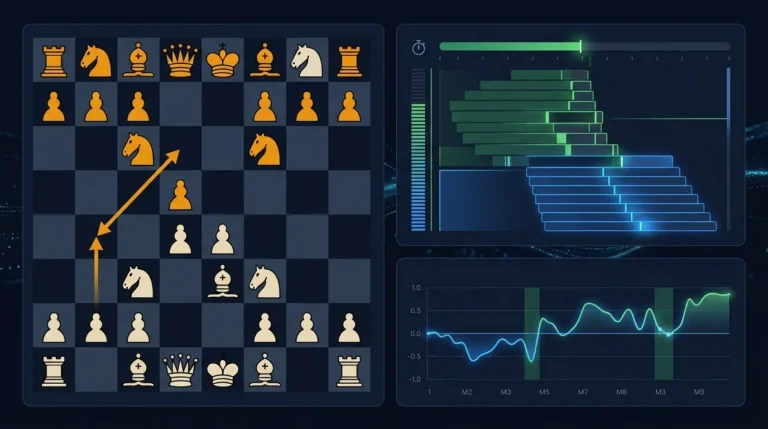
The centipawn (cp) evaluation is the engine’s numerical assessment of who stands better and by how much. One pawn is worth 100 centipawns. A score of +0.5 means White has an advantage approximately equal to half a pawn — which in a well-played game is barely noticeable. A score of +1.5 means White has the equivalent of an extra pawn and a half — a clear and likely decisive advantage at most club levels.
⚠ = Critical moment where evaluation shifted significantly. These are your analytical priority positions.
Depth matters more than most players realize. An evaluation at depth 12 and the same position at depth 22 can differ by half a pawn or more in complex tactical positions. The engine’s assessment becomes more reliable as depth increases because it is seeing further ahead. For critical positions — ones where the evaluation chart shows a large shift — always analyze at depth 22 or higher. ChessAlgo’s depth slider goes up to 25, which provides extremely deep, reliable analysis for even the most complex middlegame positions.
ChessAlgo shows three principal variation lines simultaneously. Line 1 is the engine’s best move. Lines 2 and 3 are the next best alternatives. Always read all three. The evaluation gap between Line 1 and Line 2 tells you how “forced” the position is: a large gap (0.5+ pawns) means there is really only one good move. A small gap means multiple reasonable continuations exist — these are the positions where understanding the strategic choice is most valuable for your development.
When Stockfish suggests a move that seems counterintuitive — retreating a piece, making a quiet preparatory move, sacrificing material — do not dismiss it as “computer chess.” Force yourself to understand the logic. Play the suggestion on the board and then play a few moves of the principal variation forward. Most of the time, the engine’s reasoning becomes clear three to five moves later. That moment of understanding is worth more than any tactical pattern you could drill.
What to Focus On at Your Rating Level
One of the biggest mistakes in chess analysis is applying the same analytical focus regardless of rating. A 700-rated player trying to analyze strategic subtleties is wasting time. A 1600-rated player spending all their analysis time looking for missed tactics is missing larger issues. Effective analysis is calibrated to your current level of play.
| Rating Range | Primary Analysis Focus | Key Question to Ask | Time Per Game |
|---|---|---|---|
| 600 – 1,000 | Hanging pieces, one-move blunders, basic checkmates | “Was any piece undefended?” | 15–20 min |
| 1,000 – 1,400 | Development, opening principles, piece activity | “Were all my pieces active by move 15?” | 20–30 min |
| 1,400 – 1,800 | Pawn structure, plans, phase transitions | “Did I have a clear plan, or was I reacting?” | 30–45 min |
| 1,800+ | Prophylaxis, endgame precision, subtle improvements | “What was my opponent trying to do, and did I prevent it?” | 45–60 min |
5 Analysis Mistakes That Kill Improvement
Over eight years of coaching, I have seen the same analysis errors repeated constantly — by beginners and experienced club players alike. These are not just time-wasting habits; they are actively harmful because they create the illusion of analysis without producing any real learning.
Using ChessAlgo to Analyze Any Position
ChessAlgo was built specifically to make this analysis process accessible without the friction of account signups, analysis limits, or paywalls. Every position in this guide can be analyzed in seconds using the free Stockfish calculator — including complex endgame positions, opening deviations, and tactical puzzles from your own games.
To analyze a specific position from your game using ChessAlgo:
- 01 Copy the FEN string of the position you want to analyze. You can get this from your Chess.com or Lichess game review — every position in a game has a FEN string that you can copy in one click.
- 02 Paste the FEN into the FEN input bar below the board on the ChessAlgo calculator page. The board updates instantly to show the position.
- 03 Set your depth. For most analysis, depth 20 is excellent. For complex tactical or endgame positions, push to depth 22–25 for deeper verification.
- 04 Press Find Best Move and read all three engine lines, not just the top suggestion. The evaluation gap between lines tells you how forced the position is.
Before moving to the next critical moment in your game: ① Have you read all three engine lines? ② Have you written one sentence explaining the strategic reason? ③ Have you compared the engine’s suggestion to your pre-engine annotation? ④ Have you noted whether this is a pattern you have seen before? Only when you can answer yes to all four should you advance to the next position.
Analyze Your Next Game with ChessAlgo
Free Stockfish analysis at depth 25. Three engine lines. Evaluation bar. No account required. No daily limits. Paste any FEN and get grandmaster-level analysis in seconds.
⚡ Open Free Calculator →- Always complete a blind review before running the engine — replay the game, mark critical moments, and write your own assessment first. This is the step that produces actual improvement.
- The 7-step method: get PGN → first pass → mark critical moments → your analysis → engine analysis → compare → extract lessons and update your pattern log.
- Run Stockfish at depth 20+ for standard positions and depth 22–25 for tactical or endgame positions. Read all three engine lines, not just the top move.
- Centipawn evaluations below ±0.5 mean the position is roughly equal. Shifts of 1.0+ are your analytical priorities. Shifts of 2.0+ are game-changing errors worth studying in depth.
- Calibrate your focus to your rating: tactics and hanging pieces (sub-1000), piece activity and development (1000–1400), pawn structure and plans (1400–1800), prophylaxis and precision (1800+).
- Analyze wins with the same rigour as losses. Your wins often reveal exactly the strategic thinking you need to develop — and they are harder to spot emotionally.
- Write at least one clearly articulated lesson per analysis session. Observations are not lessons. Patterns are lessons.
Frequently Asked Questions
Conclusion
Game analysis is not a luxury for serious players — it is the engine of improvement. Playing without it is the chess equivalent of practising a musical instrument without ever listening back to the recording. You will repeat your mistakes indefinitely, wonder why your rating has not moved in months, and assume you just need to play more games.
The method in this guide is not complicated. Play through the game. Find the moments where the game changed. Think about them yourself before asking Stockfish. Compare your thinking to the engine’s. Write down one lesson. Repeat until you have a pattern log that reflects your specific, personal blindspots as a chess player. That pattern log, built over twenty to thirty analyzed games, is worth more than any chess course, any opening book, and any number of rapid games played without reflection.
Use ChessAlgo’s free Stockfish calculator at every stage of this process. The engine is there to check your thinking, not to do it for you. Bring your own analysis — then let the algorithm tell you where you were right and where you were not.